# Section 2.2: 1Password App for Mac & Windows - Setup
Now that the 1Password app has been installed on your computer, it's time to sign in and configure it. The primary way of signing into the 1Password app for Mac or Windows is to use the Account Details. A second way to sign in, if the account is already signed into the 1Password mobile app (e.g. on iPhone), is to scan a QR code. This is slightly different than scanning a QR code to sign in on the mobile app, but the process is very similar.
**Generally you should not have to setup the 1Password app for macOS or Windows; the IT tech team will do this for you. Please contact IT if you have any questions.**
# App Setup Method 1: Sign In with Account Details
[](https://bookstack.reinmuthconsulting.com/uploads/images/gallery/2023-09/sU0NVzpSBYWfL2Qo-1pw-icon-460x0w.png)
## Sign in and Configure the 1Password App with Account Details
For this section you will need your Account Details from **Section 1**:
* **Sign-in Address**
* **Email Address** (a.k.a. username)
* **Secret Key** (a.k.a. Access Key)
* **Password** (a.k.a. your master password)
You won't be able to complete the sign in process without them. You should have them open in a browser window if you've already completed **Section 1**. See **Section 1: Retrieving Your 1Password Account Info** if you haven't.
If this isn't the first computer you're setting up with the 1Password app, these Account Details can be found in your Vault. If you're unable to retrieve your account details, contact IT for assistance.
Once you have access to your Account Details, continue with **Step 1** of this section.
You will also need the 1Password app installed and open. Installation is covered in **Section 2.1**.
* * *
## **Step 1: Sign In**
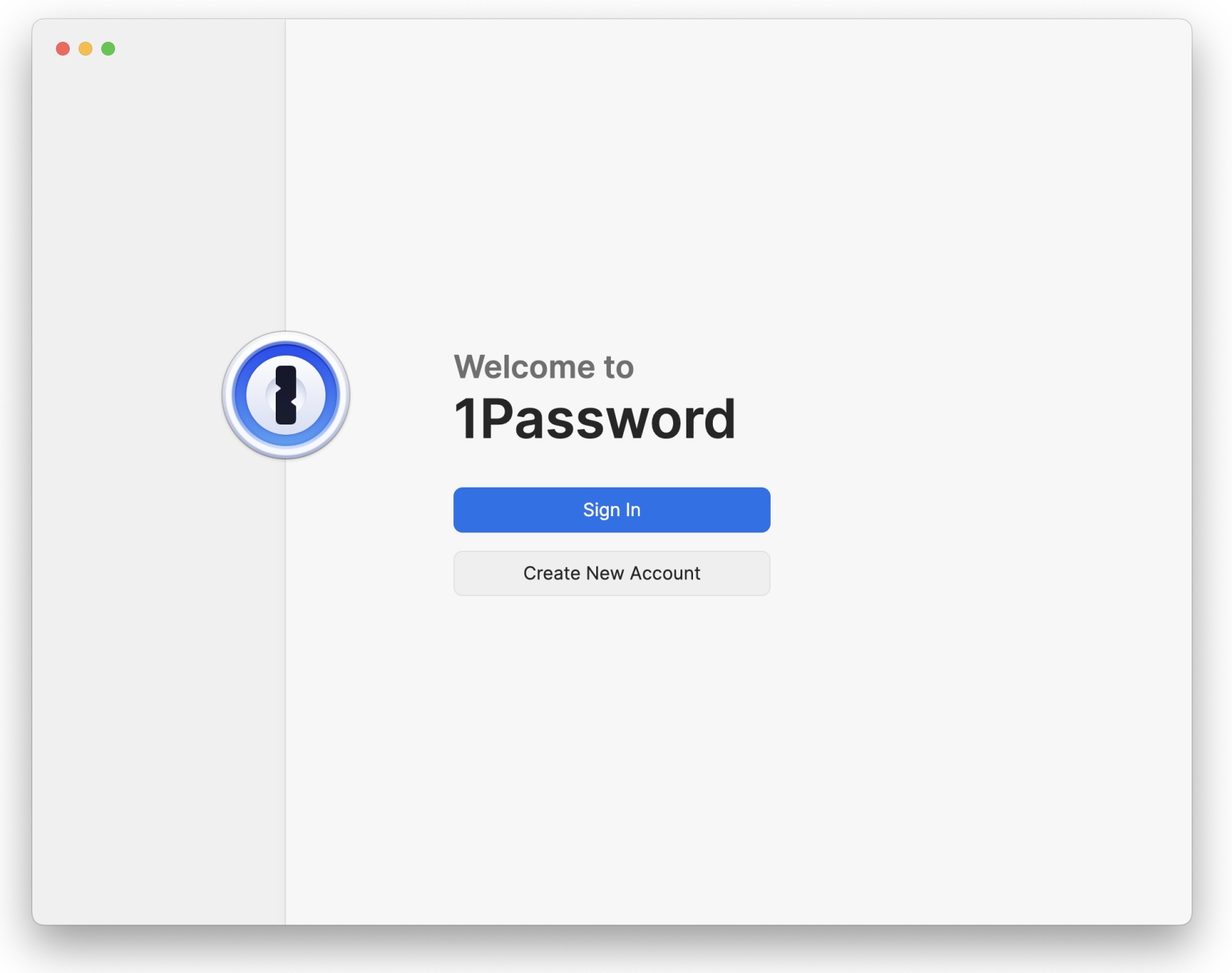
Click Sign In to begin the process of adding your account to the app.
[](https://bookstack.reinmuthconsulting.com/uploads/images/gallery/2023-09/1Oq7Cx0ajvCtBReW-1pw-app-4-login-screen.png)
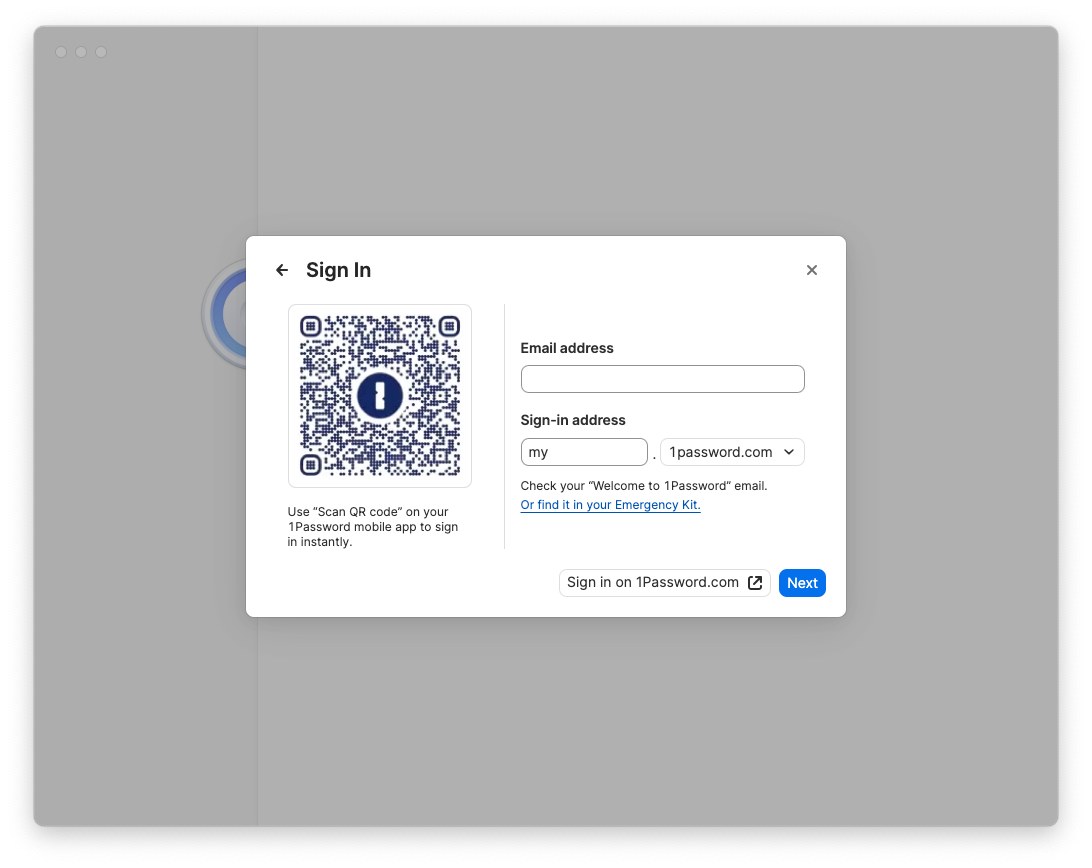
You will be prompted to enter the Email address and Sign-in address for the account. Enter them and click Next.
[](https://bookstack.reinmuthconsulting.com/uploads/images/gallery/2025-01/wvuCggk4c7aG4e27-1pw-app-6-login.png)
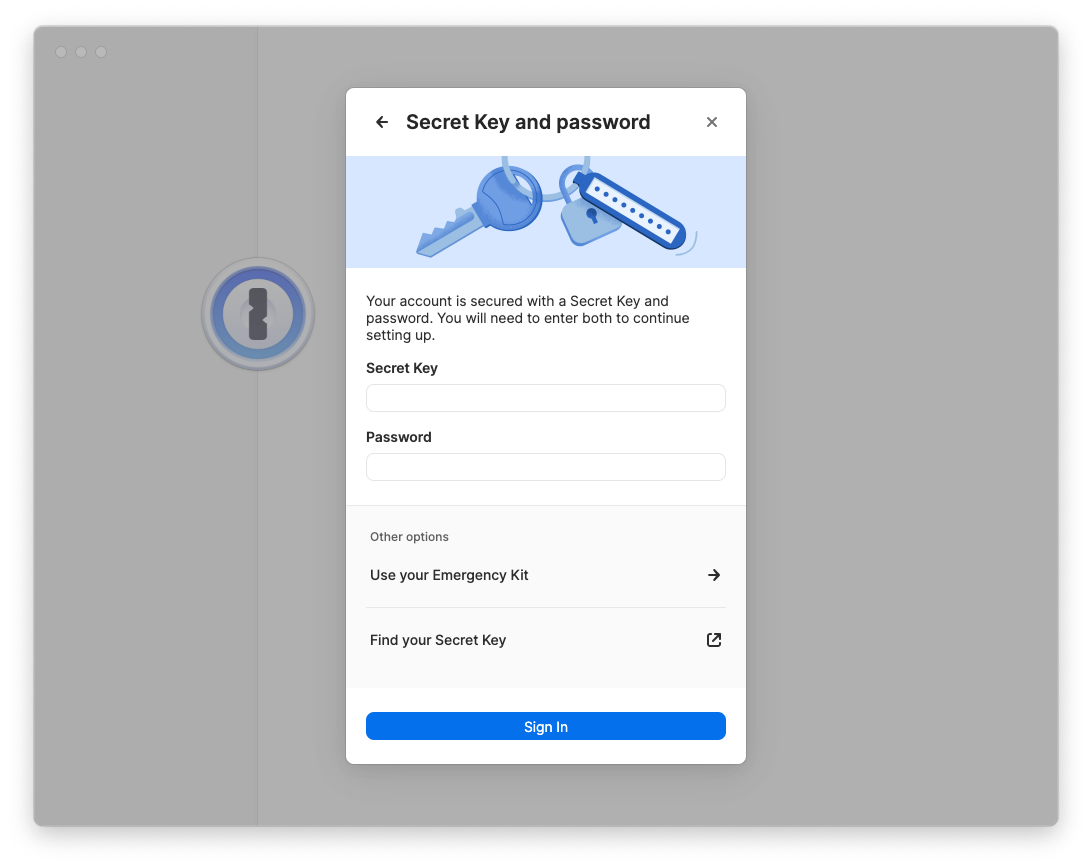
Next you need to enter the Secret Key and the Password.
[](https://bookstack.reinmuthconsulting.com/uploads/images/gallery/2025-01/LItKnCY5HFznNGd5-1pw-app-6-login-2.png)
The Sign-In Address is the same for everyone, but your email, Secret Key, and Password are unique to your account. If you can't find these, you will need to retrieve them, which is covered in **Section 1**.
Once the account info is entered, click Sign In.
>🧠
>
>Remember: Please do not write down (or print) either the Password or the Secret Key. The password is your "one" password, your master password, and your memorization of it is critical. The Secret Key is kept safe by the IT staff if you need it in the future.
>📌
>
>Note: If you find that your password is difficult for you to type or remember, you do have the option of changing it later. If you'd like to change your master password, the process is covered in **Section 4**.
* * *
## **Step 2: Configure**
Make sure the 1Password app is active/focused by clicking on its window or the app icon in the Dock.
Head up to the menu bar and click the 1Password menu ➝ Settings.
You will need to change settings in three different tabs:
* **General**
* **Security**
* **Privacy**
#### **General**
In the General tab, under the **Default Vault** heading, change the Save new items in: setting from "Suggest a vault" or "Employee" or "Private" to **your _named vault_** e.g. `John Doe`.
To be clear: Default Vault should be the user, not Employee.
> 📌
>
> As of May 1, 2024 the name of the "Private" vault has been changed to "Employee" for 1Password business accounts. This change was not made by us but [by the developers](https://blog.1password.com/employee-vault/) of 1Password. Please continue to leave the Employee vault empty.
#### **Security**
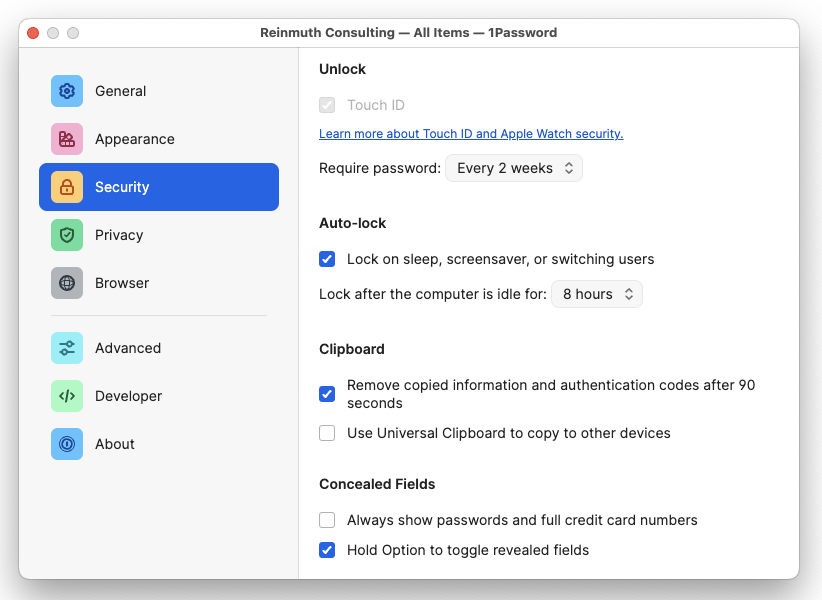
If the device has **Touch ID**, make sure it is enabled if you are Ok with using Biometric Authentication. Set "**Confirm my account password:**" to `Every 2 weeks` (14 days). This setting will allow you to unlock 1Password with the Touch ID sensor rather than entering your password. However, this will only work for 14 days before you will need to enter your password again to start another 14 day period.
Under the **Auto-lock** heading, set the "**Lock after the computer is idle for:**" setting to ``8 hours``. For comparison, your computer should "lock" after a period of idle time when you're not using it (i.e. not typing or moving the mouse) at which point you will need to enter your macOS password (different from your 1Password password). This setting is similar to that, but in this case, the 1Password app will lock after the computer has been idle for 8 hours. At which point you will need to use Touch ID or enter your 1Password password.
Finally, under the **Concealed Fields** heading, **enable** the "**Hold Option to toggle revealed fields**" setting. This is a handy little feature that most users won't use, but IT uses it consistently. If you hold `option` (aka `alt`) on your keyboard while in the 1Password app, it will reveal concealed secrets like passwords.
Feel free to lock this down further; these are the minimums. For Example, setting "Lock after the computer is idle" to `4 hours`, rather than just `8 hours`.
#### **Privacy**
Under the **Watchtower** heading, **disable** the setting labeled "**Check for passkeys**" because we do not use passkeys currently.
#### **To reiterate: These are the standardized settings you should have..**
> * General Tab
> * Default Vault
> * `Save new items in:` should be set to your _named vault_ e.g. `John Doe`. It should not be set to "Employee" or "Private" or "Suggest a vault".
>
> * Security Tab
> * Unlock: Touch ID should be enabled for Mac (if available) ✅
> * Auto-Lock:
> * Set `Lock after the computer is idle for:` to **8 hours**. You may set a more strict time such as 4 hours.
> * Check ✅ `Lock on sleep...`
> * Clipboard:
> * Check ✅ `Remove copied information...`
> * Uncheck 🔲 `Use Universal Clipboard...`
> * Concealed Fields:
> * Uncheck 🔲 `Always show passwords...`
> * Check ✅ `Hold Option to toggle revealed fields`
> * Privacy
> * Watchtower
> * Uncheck 🔲 `Check for passkeys`
Close the Settings window after you have finished with both the General and Security settings.
* * *
## **Step 3: Proceed to Section 3!**
You're done!... at least with this part. Continue to **Section 3** to install the browser plugin/extension of your choice. If you have any questions, contact IT for help.
# App Setup Method 2: Scan QR Code (requires mobile device)

## Sign in and Configure the 1Password App with Your Mobile Device
For this section you will need your mobile device (iPhone, Android, etc) with the 1Password app installed and already signed in. If you've never signed into the 1Password app on your mobile device, you will not be able to proceed with this method of Mac/Windows app setup.
If you're not sure what to do, contact IT and they can help.
You will also need the Mac/Windows 1Password app installed and open. Installation is covered in **Section 2.1**.
* * *
## **Step 1: Click Sign In to Show the QR Code**
Click Sign In to begin the process of adding your account to the app.

The Sign In prompt will appear. On the left side there is a QR code that you will need to scan with your mobile device.

* * *
## **Step 2: Scan the QR code with Your Mobile Device**
Open the 1Password app on your mobile device. Tap the icon in the top left to bring up the menu. Tap the option for Scan QR Code... and then maneuver your mobile device's camera to capture the QR code displayed in the Mac/Windows 1Password app.
Once the mobile app recognizes the QR code, tap the button to Allow Full Access and the Mac/Windows app will sign in to the account automatically.
* * *
## **Step 3: Configure**
Make sure the 1Password app is active/focused by clicking on its window or the app icon in the Dock.
Head up to the menu bar and click the 1Password menu ➝ Settings.
You will need to change settings in three different tabs:
* **General**
* **Security**
* **Privacy**

#### **General**
In the General tab, under the **Default Vault** heading, change the Save new items in: setting from "Suggest a vault" or "Employee" or "Private" to **your _named vault_** e.g. `John Doe`.
To be clear: Default Vault should be the user, not Employee.
> 📌
>
> As of May 1, 2024 the name of the "Private" vault has been changed to "Employee" for 1Password business accounts. This change was not made by us but [by the developers](https://blog.1password.com/employee-vault/) of 1Password. Please continue to leave the Employee vault empty.
#### **Security**
If the device has **Touch ID**, make sure it is enabled if you are Ok with using Biometric Authentication. Set "**Confirm my account password:**" to `Every 2 weeks` (14 days). This setting will allow you to unlock 1Password with the Touch ID sensor rather than entering your password. However, this will only work for 14 days before you will need to enter your password again to start another 14 day period.
Under the **Auto-lock** heading, set the "**Lock after the computer is idle for:**" setting to ``8 hours``. For comparison, your computer should "lock" after a period of idle time when you're not using it (i.e. not typing or moving the mouse) at which point you will need to enter your macOS password (different from your 1Password password). This setting is similar to that, but in this case, the 1Password app will lock after the computer has been idle for 8 hours. At which point you will need to use Touch ID or enter your 1Password password.
Finally, under the **Concealed Fields** heading, **enable** the "**Hold Option to toggle revealed fields**" setting. This is a handy little feature that most users won't use, but IT uses it consistently. If you hold `option` (aka `alt`) on your keyboard while in the 1Password app, it will reveal concealed secrets like passwords.
Feel free to lock this down further; these are the minimums. For Example, setting "Lock after the computer is idle" to `4 hours`, rather than just `8 hours`.
#### **Privacy**
Under the **Watchtower** heading, **disable** the setting labeled "**Check for passkeys**" because we do not use passkeys currently.
#### **To reiterate: These are the standardized settings you should have..**
> * General Tab
> * Default Vault
> * `Save new items in:` should be set to your _named vault_ e.g. `John Doe`. It should not be set to "Employee" or "Private" or "Suggest a vault".
>
> * Security Tab
> * Unlock: Touch ID should be enabled for Mac (if available) ✅
> * Auto-Lock:
> * Set `Lock after the computer is idle for:` to **8 hours**. You may set a more strict time such as 4 hours.
> * Check ✅ `Lock on sleep...`
> * Clipboard:
> * Check ✅ `Remove copied information...`
> * Uncheck 🔲 `Use Universal Clipboard...`
> * Concealed Fields:
> * Uncheck 🔲 `Always show passwords...`
> * Check ✅ `Hold Option to toggle revealed fields`
> * Privacy
> * Watchtower
> * Uncheck 🔲 `Check for passkeys`
Close the Settings window after you have finished with both the General and Security settings.
* * *
## **Step 4: Proceed to Section 3!**
You're done!... at least with this part. Continue to **Section 3** to install the browser plugin/extension of your choice. If you have any questions, contact IT for help.